> ## Documentation Index
> Fetch the complete documentation index at: https://docs.zenrows.com/llms.txt
> Use this file to discover all available pages before exploring further.
# How to Integrate Dify with Zenrows
> Install the official Zenrows plugin from the Dify Marketplace and add Fetch, Extract, and Batch tools to your Dify workflows and agents, including pages behind anti-bot protection and heavy JavaScript.
Install the official Zenrows plugin from the Dify Marketplace and your Dify workflows and agents can read live web pages, including the ones that return a block page to an ordinary HTTP request. There's no custom code to write, no API schema to import, and no HTTP node to configure: the plugin adds five ready-made tools to the Dify tool picker.
## What Is Dify?
Dify is an open-source platform for building LLM applications. You assemble workflows, chatflows, and agents on a visual canvas by connecting nodes such as LLM calls, knowledge retrieval, code, and tools. It runs as a hosted service at `cloud.dify.ai` or self-hosted on your own infrastructure.
Dify's plugin system lets third parties ship tools that show up next to the built-in ones. The Zenrows plugin is one of them, published and maintained by Zenrows.
## Why Connect Zenrows to Dify?
* **Workflows that don't get blocked:** a plain HTTP request to a site behind Cloudflare, DataDome, or similar gets a challenge page, and the LLM node then reasons over the wrong content. Zenrows returns the real page.
* **Markdown by default:** the Fetch tool returns clean Markdown, which costs far fewer tokens than raw HTML when you pass it to an LLM node.
* **Structured data without parsing code:** the Extract tool returns JSON fields, so you don't need a Code node to pull prices or titles out of HTML.
* **Many URLs in one job:** the Batch tools submit up to 1,000 URLs per call as an asynchronous job (a plugin limit), instead of looping a Fetch node.
* **One credential for the workspace:** you authorize the plugin once, and every member of the workspace can use it in their apps.
## Available Tools
The plugin adds five tools under the **Zenrows** provider:
| Tool | What it does |
| - | - |
| **Fetch** | Retrieves one page as Markdown, HTML, plain text, or PDF. A separate **Screenshot** option returns an image instead. Supports JavaScript rendering, Premium Proxies, proxy country, wait conditions, and JavaScript instructions. |
| **Extract** | Returns structured JSON from a page. Pick a method: `auto` (site-tailored, falls back to autoparse), `autoparse` (any site), `css` (your own CSS selectors), or `outputs` (built-in filters such as emails, links, and tables). |
| **Batch Create** | Submits 1 to 1,000 URLs per call as one asynchronous job and returns a job ID. The 1,000 limit comes from the plugin; the Batch API itself accepts up to 100,000 URLs per job. It can also wait up to about 100 seconds for a small job to finish. |
| **Batch Status** | Reports a job's progress: completed, successful, and failed task counts, failure reasons, and credits spent. |
| **Batch Results** | Collects the scraped content of a finished job, 25 results by default and up to 200 per call. |
Use Fetch when you want the page, Extract when you want fields from the page, and Batch when you have more URLs than one request should carry.
## Prerequisites
* A Dify workspace, either on Dify Cloud or self-hosted. Self-hosted instances need Dify 1.11.4 or later.
* A Zenrows API key from your Zenrows dashboard.
* For self-hosted Dify: outbound HTTPS access to `api.zenrows.com` and `async.api.zenrows.com`. The plugin needs no inbound connections.
## Set Up the Zenrows Plugin
Open the Zenrows plugin page and click **Install**. Dify opens your workspace and installs the plugin. You can also search for **Zenrows** from **Marketplace** in the Dify sidebar.
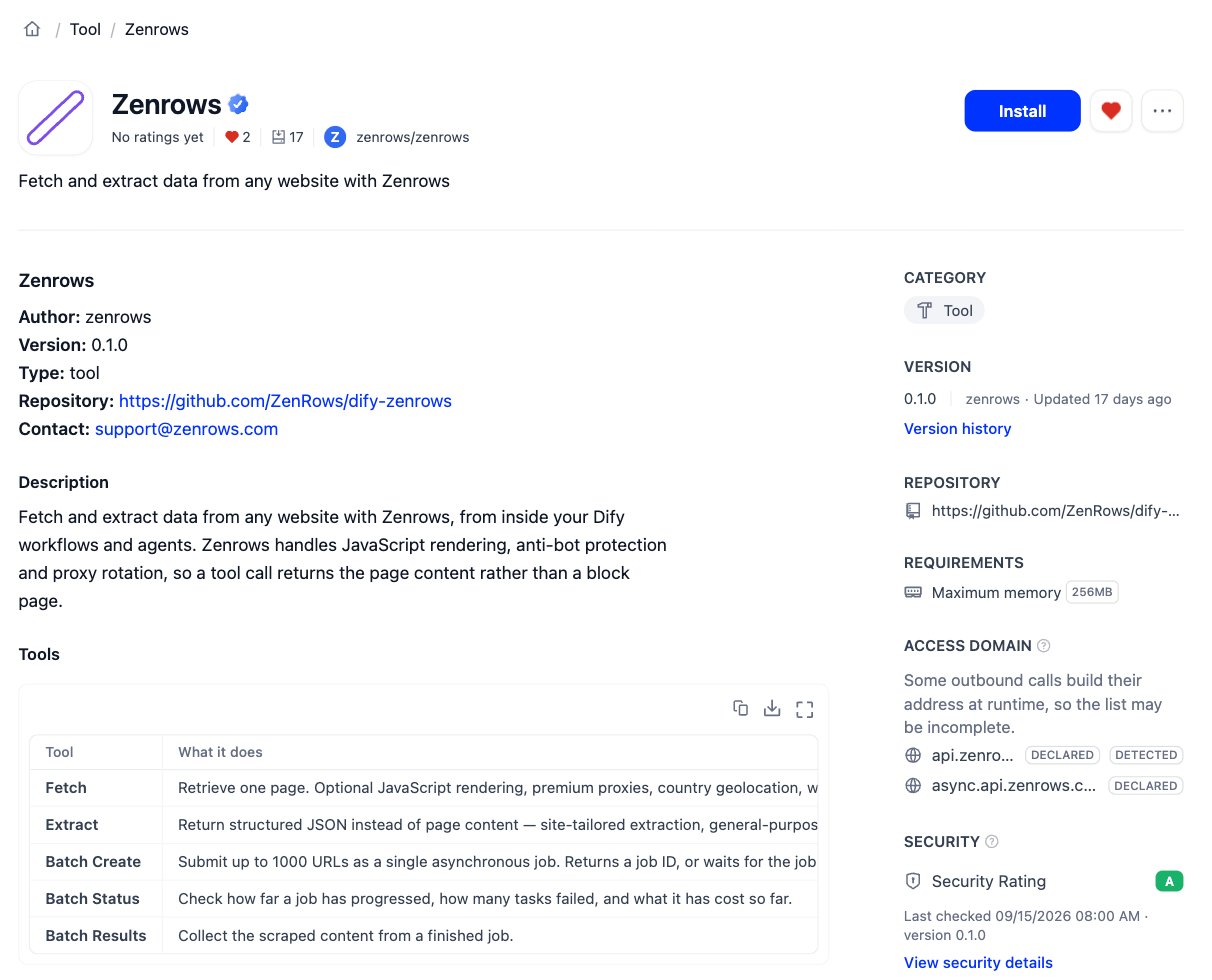 When installation finishes, Dify shows an **Installation successful** dialog, and Zenrows appears under **Integrations** > **Tools** > **Tool Plugin**.
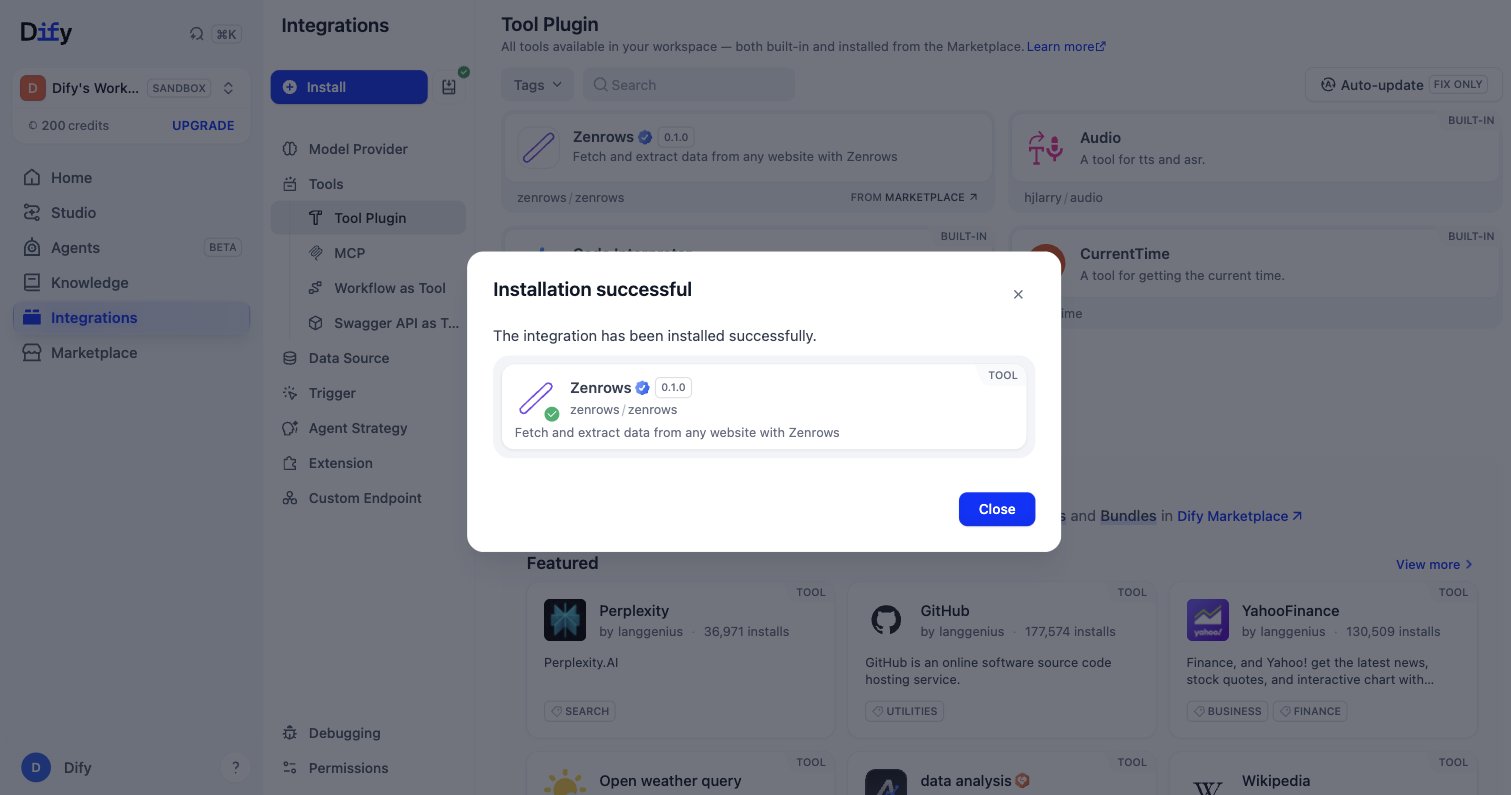 In **Integrations** > **Tools** > **Tool Plugin**, click the **Zenrows** card, then click **API Key Authorization Configuration**. Fill in the dialog:
* **Authorization Name**: any label, for example `Zenrows`.
* **Zenrows API Key**: paste your key from the Zenrows dashboard.
* **Who can use**: leave **All team members**, or restrict it.
Click **Save**. Dify validates the key with Zenrows before saving it, and the check doesn't consume credits.
In **Integrations** > **Tools** > **Tool Plugin**, click the **Zenrows** card, then click **API Key Authorization Configuration**. Fill in the dialog:
* **Authorization Name**: any label, for example `Zenrows`.
* **Zenrows API Key**: paste your key from the Zenrows dashboard.
* **Who can use**: leave **All team members**, or restrict it.
Click **Save**. Dify validates the key with Zenrows before saving it, and the check doesn't consume credits.
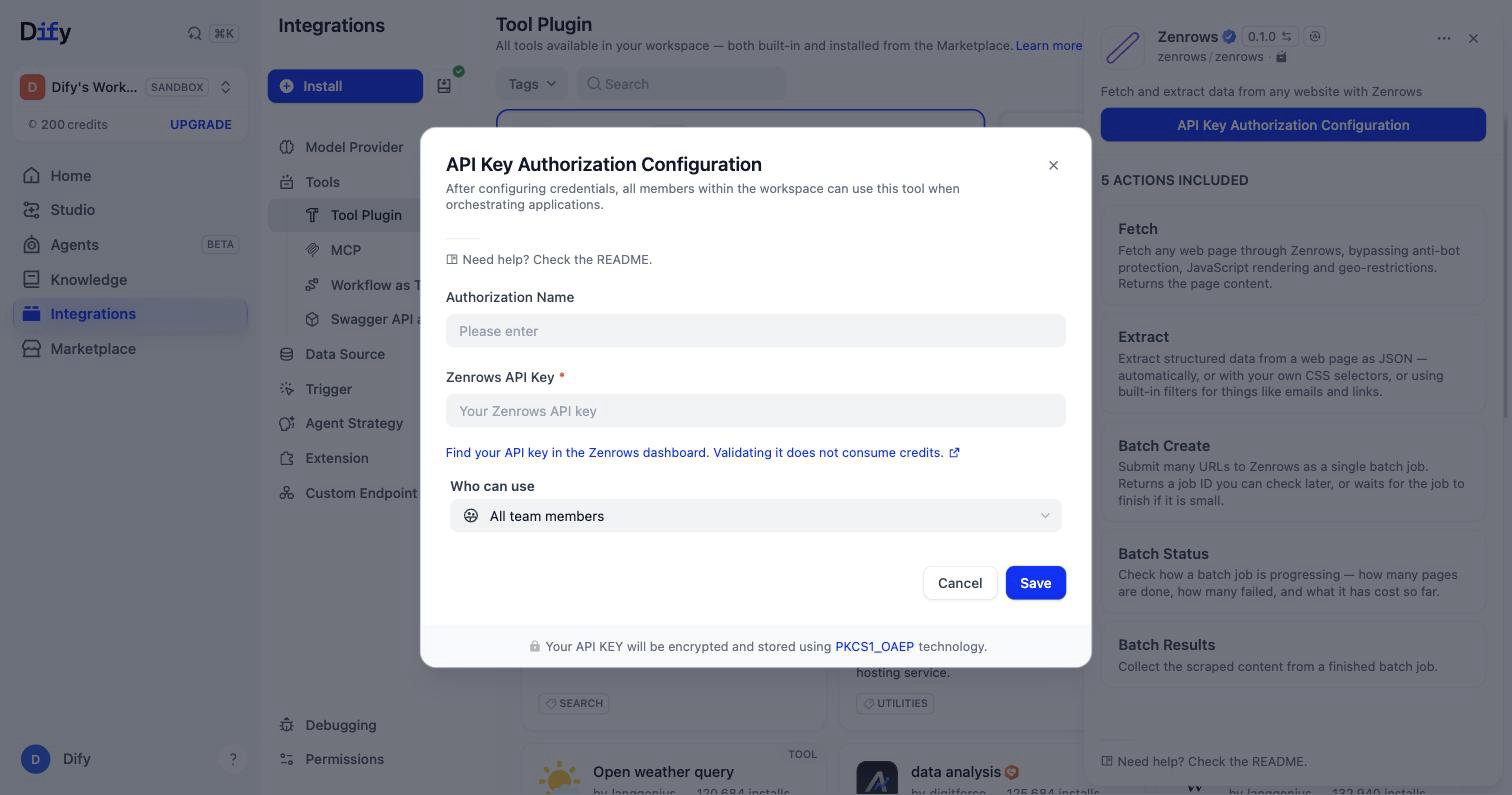 The plugin panel now shows **1 Authorization** with a green indicator, and lists the five actions.
 ## Build a Workflow That Summarizes Any Web Page
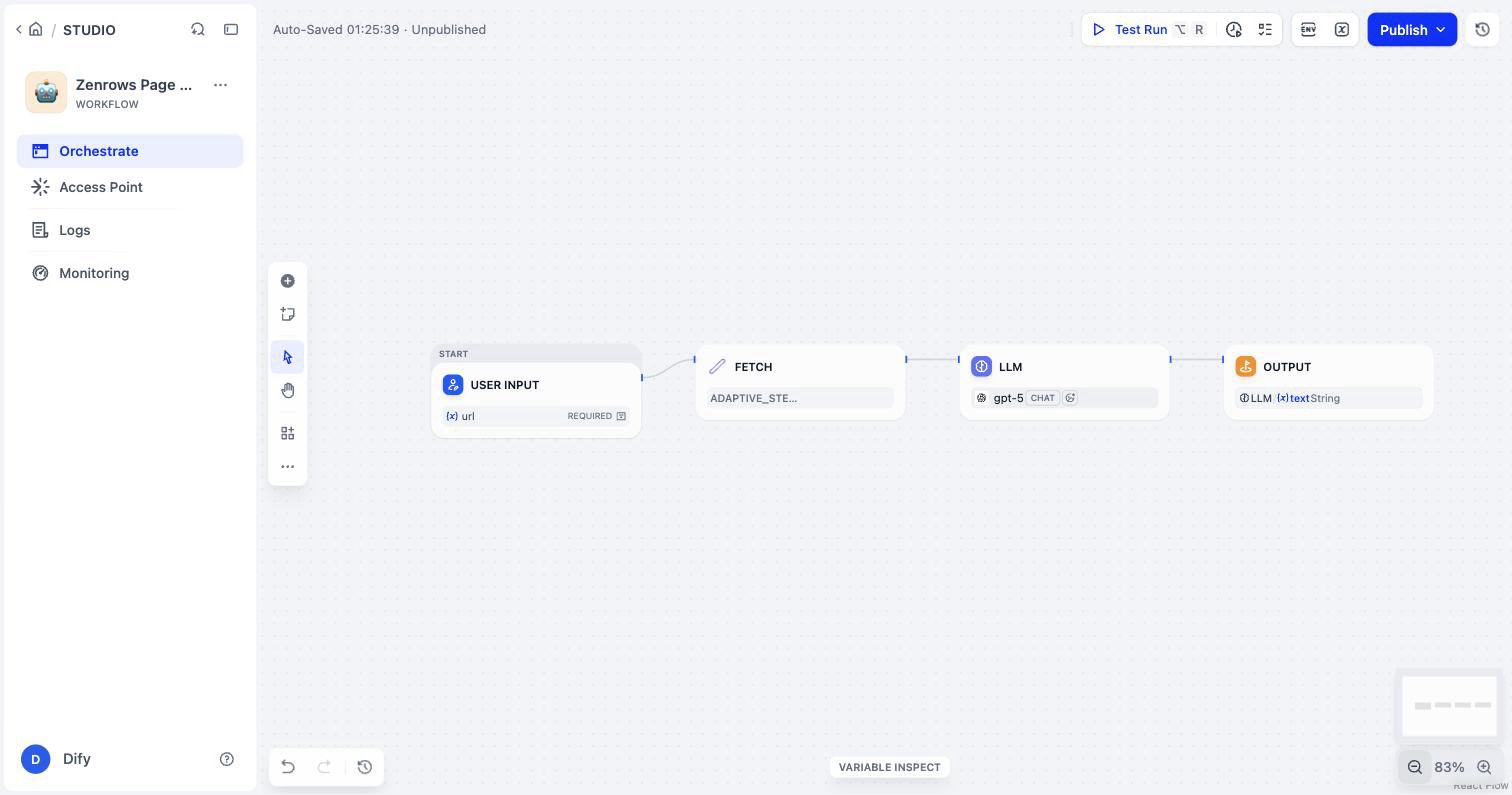
This example builds a four-node workflow: it takes a URL, fetches the page through Zenrows as Markdown, has an LLM summarize it, and returns the summary.
In **Studio**, click **Create from Blank**, choose **Workflow**, name it, and click **Create**. Pick **User Input** as the start node, then click **+** next to **Input Field** and add a **Short Text** field with the variable name `url`.
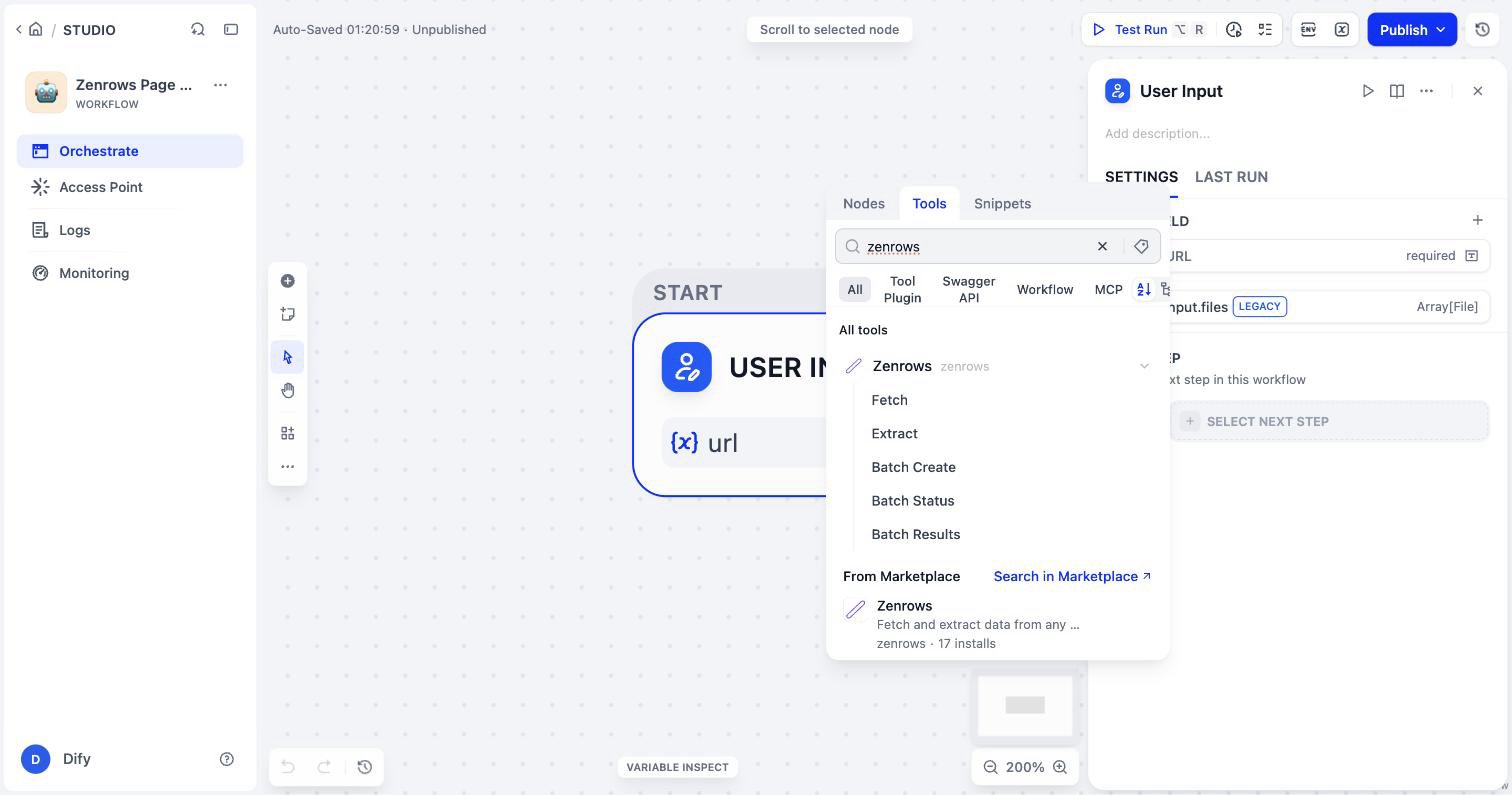
Under **Next Step**, click **Select Next Step**, open the **Tools** tab, search for `zenrows`, and click **Fetch**.
## Build a Workflow That Summarizes Any Web Page
This example builds a four-node workflow: it takes a URL, fetches the page through Zenrows as Markdown, has an LLM summarize it, and returns the summary.
In **Studio**, click **Create from Blank**, choose **Workflow**, name it, and click **Create**. Pick **User Input** as the start node, then click **+** next to **Input Field** and add a **Short Text** field with the variable name `url`.
Under **Next Step**, click **Select Next Step**, open the **Tools** tab, search for `zenrows`, and click **Fetch**.
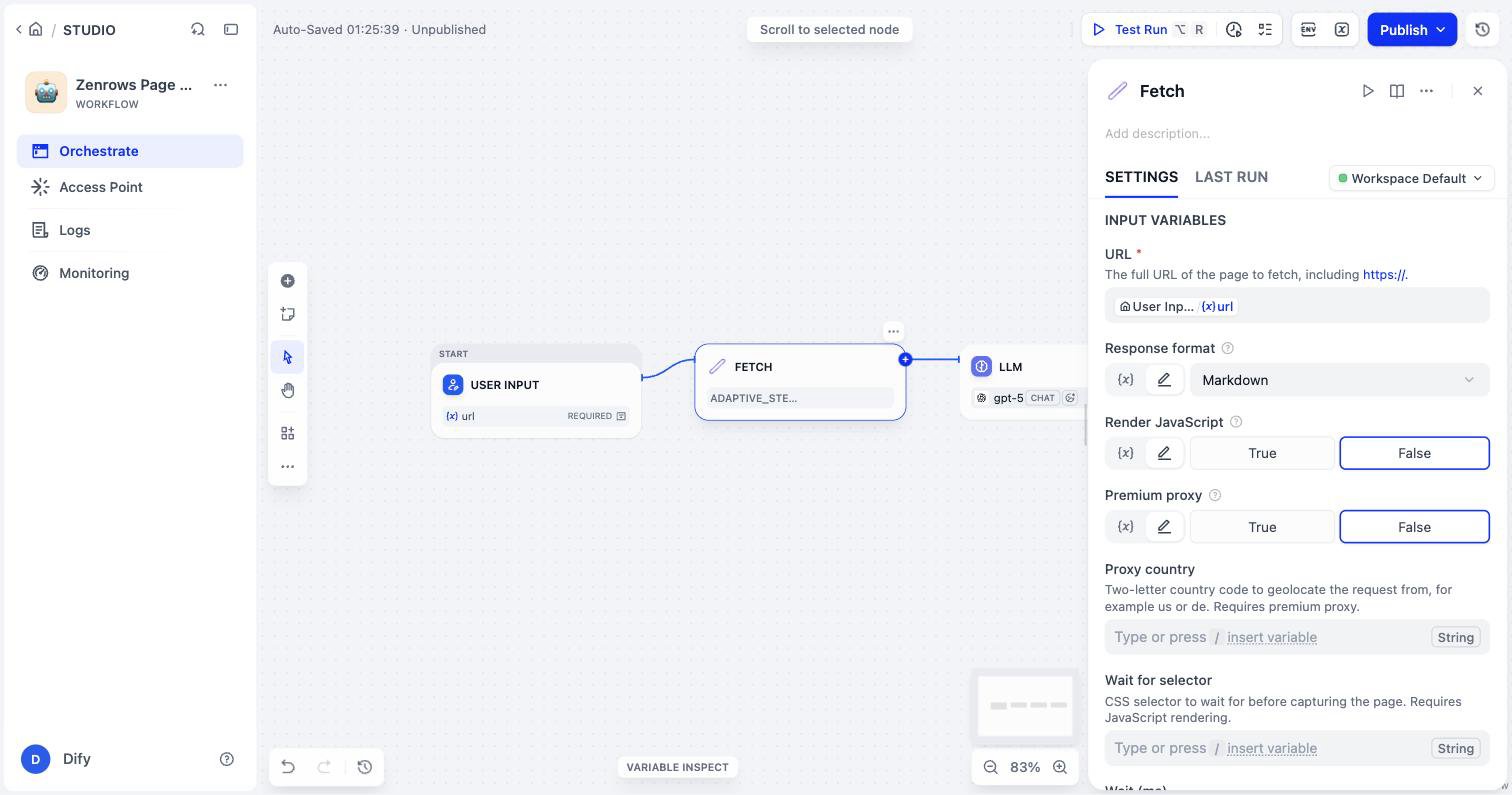
 In the Fetch node's **URL** field, type `/` and select the **User Input** `url` variable. Leave **Response format** on **Markdown** and the other settings at their defaults.
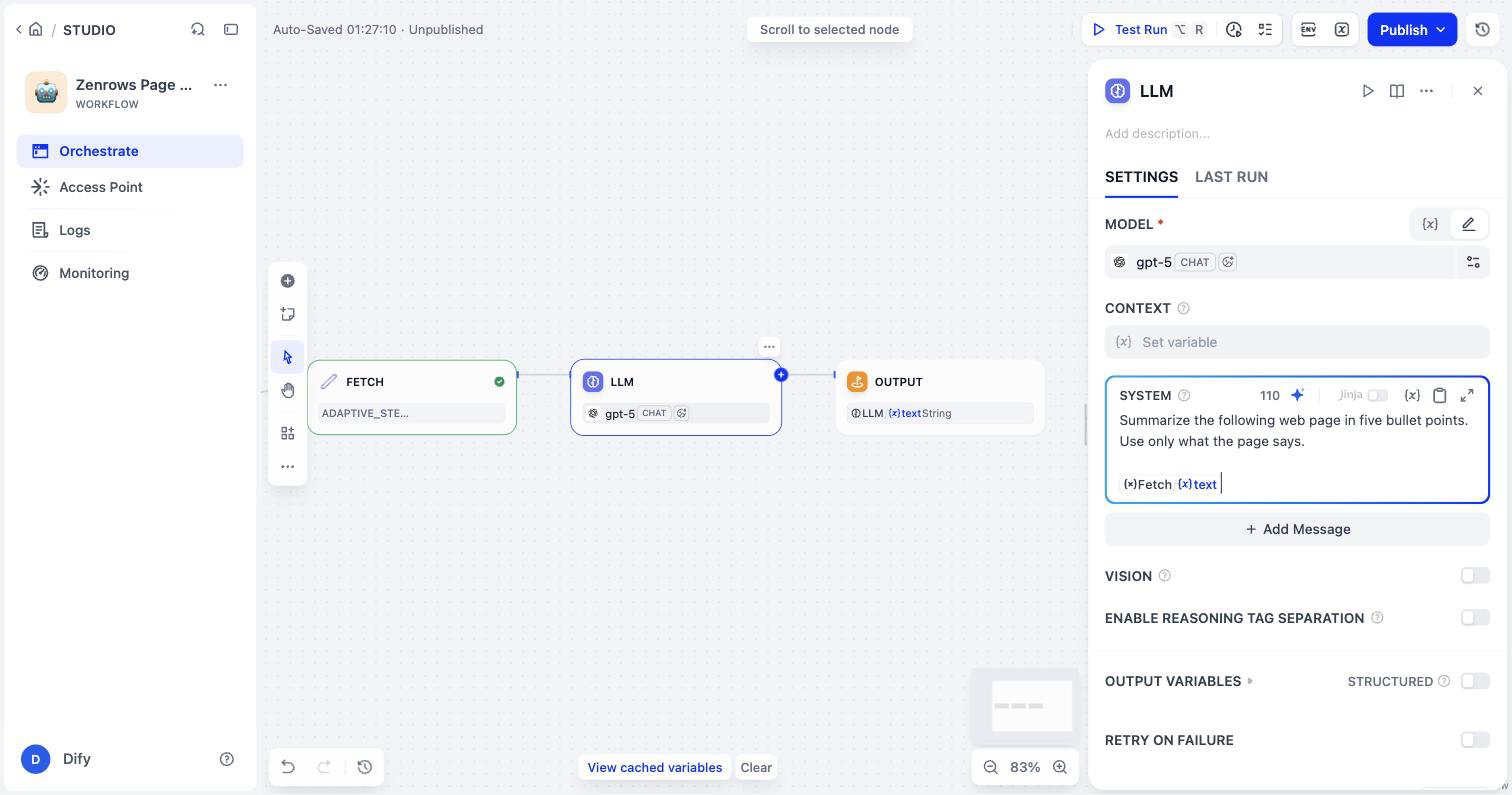
 From the Fetch node, add an **LLM** node. In its **System** prompt, write an instruction such as `Summarize the following web page in five bullet points. Use only what the page says.` On a new line, type `{` and select the Fetch node's **`text`** variable.
 **Use `text`, not `content`.** The Fetch node's output list in Dify also shows `content`, `url`, and `status_code`, but in plugin version 0.1.0 those aren't populated as variables. Referencing `content` fails the run with `Variable ... content# not found`. The page content arrives in `text`, and the same fields are available inside the `json` output.
From the LLM node, add an **Output** node with one variable, `summary`, set to the LLM node's `text`. The finished workflow looks like this:
**Use `text`, not `content`.** The Fetch node's output list in Dify also shows `content`, `url`, and `status_code`, but in plugin version 0.1.0 those aren't populated as variables. Referencing `content` fails the run with `Variable ... content# not found`. The page content arrives in `text`, and the same fields are available inside the `json` output.
From the LLM node, add an **Output** node with one variable, `summary`, set to the LLM node's `text`. The finished workflow looks like this:
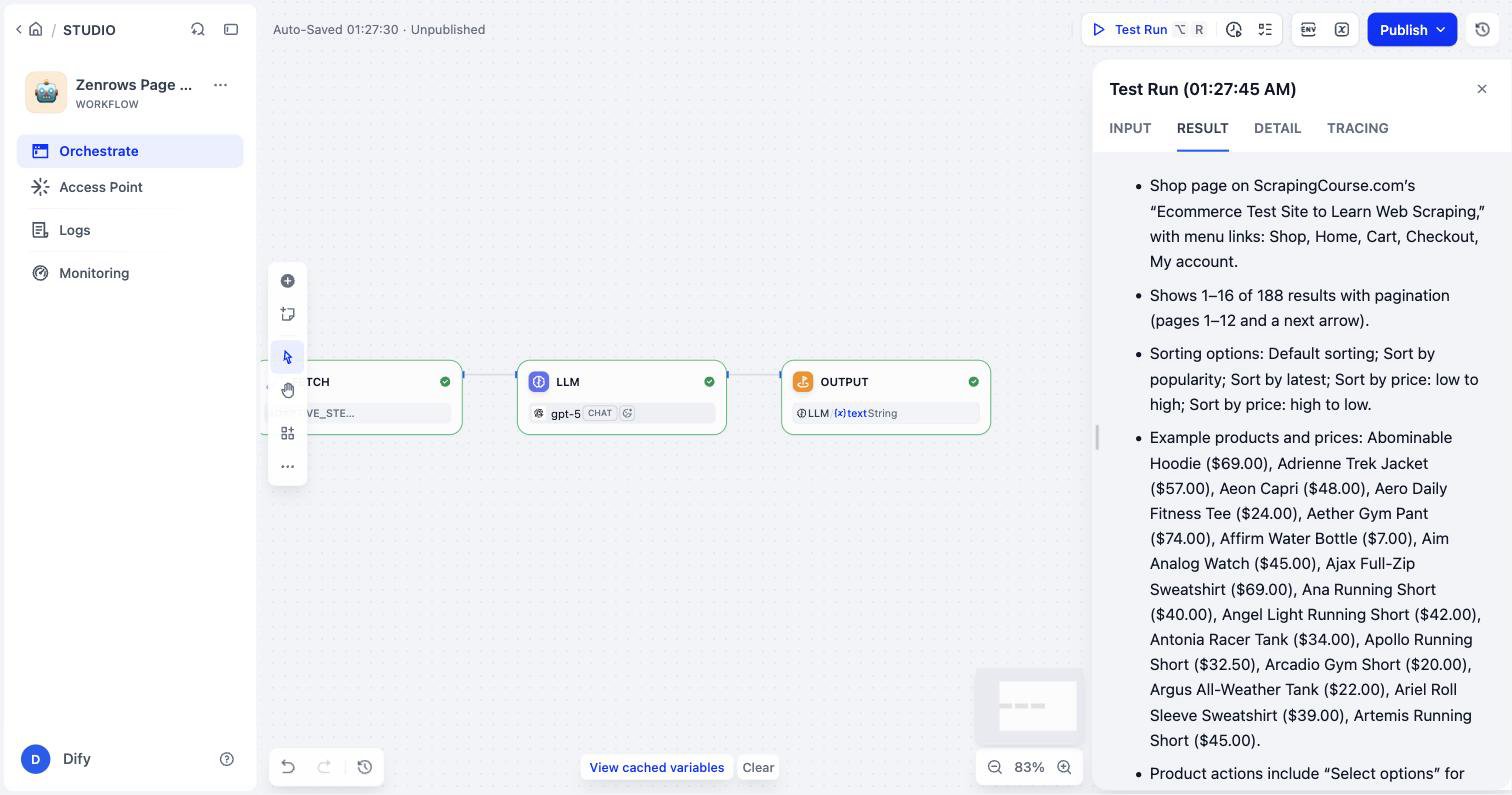
 Click **Test Run**, enter `https://www.scrapingcourse.com/ecommerce/` as the URL, and click **Start Run**. The **Result** tab shows the summary.
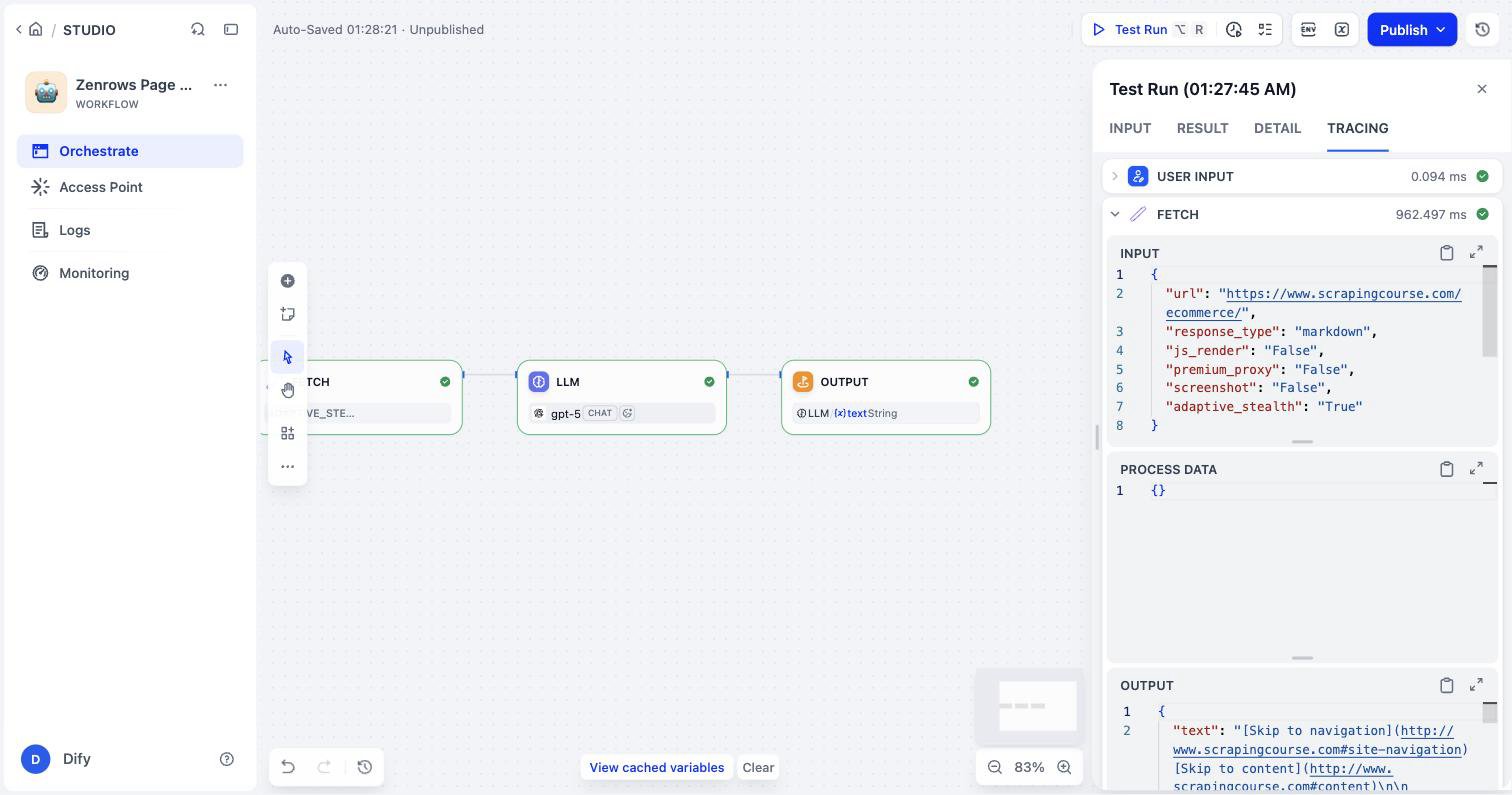
 The **Tracing** tab shows each node's input and output. For Fetch, you can confirm the parameters sent to Zenrows and the Markdown that came back.
 ## Handle Protected and JavaScript-Heavy Pages
Fetch and Extract have **Adaptive stealth** turned on by default. With it on, Zenrows starts with a basic request and escalates to JavaScript rendering or Premium Proxies only when the target needs them, so most protected pages work without changing any settings. See [Adaptive Stealth Mode](/fetch/features/adaptive-stealth-mode) for how escalation works and what it costs.
Leave the Fetch and Extract settings at their defaults unless you have a specific reason to change them. Adaptive stealth already decides when a page needs a browser or a residential IP.
## Work with Tool Outputs
Each tool returns its result in Dify's standard `text` and `json` outputs. Some also return named variables you can reference directly:
| Tool | Use downstream |
| - | - |
| **Fetch** | `text` holds the page content. `json` holds `content`, `url`, and `status_code`. A screenshot or PDF arrives in `files`. |
| **Extract** | `text` holds the extracted data as a JSON string, or a "No structured data found" message. `json` holds `data`, `method_used`, `fell_back_to_autoparse`, `empty`, and `url`. |
| **Batch Create** | `job_id`, `run_id`, `status`, `finished`, and `accepted_tasks` variables. |
| **Batch Status** | `job_id`, `status`, `finished`, `total`, `completed`, `successful`, `failed`, `failure_reasons`, and `spend` variables. |
| **Batch Results** | `results`, `returned`, and `truncated` variables. Each result has `url`, `status`, and, unless **Include page content** is off, `content`. |
For a batch, chain the tools: Batch Create, then Batch Status with the `job_id` until `finished` is `true`, then Batch Results. Leave **Wait for completion** off for more than a few dozen URLs. A tool call can't run longer than about 100 seconds, so a large job won't finish inside one call.
## Troubleshooting
### The Zenrows tools don't appear in the node picker
The plugin isn't installed in this workspace, or it has no authorization. Open **Integrations** > **Tools** > **Tool Plugin**, click **Zenrows**, and confirm the panel shows **1 Authorization**. If it shows **API Key Authorization Configuration** instead, add your key.
### Authorization fails when saving the key
Copy the key again from your Zenrows dashboard and check for leading or trailing spaces. On self-hosted Dify, confirm the instance can reach `api.zenrows.com` over HTTPS.
### `Variable ... not found` in the node after Fetch or Extract
The downstream node references `content`, `url`, `status_code`, or `data` from Fetch or Extract. Those aren't populated as variables in plugin version 0.1.0. Reference `text` instead, or read the field from the `json` output.
### "Turn off Adaptive stealth" error
The plugin rejects the request before it reaches Zenrows when Adaptive stealth is on together with **Render JavaScript**, **Premium proxy**, **Screenshot**, **PDF** as the response format, **Wait for selector**, **Wait (ms)**, or **JavaScript instructions**. Zenrows doesn't accept those combinations either.
* If you set **Render JavaScript** or **Premium proxy** to **True**, set it back to **False**. Adaptive stealth turns them on automatically when a page needs them.
* If you need a screenshot, a PDF, a wait condition, or JavaScript instructions, turn Adaptive stealth off for that node. Those options require a browser, so you also control rendering and proxies yourself.
### The page comes back empty or incomplete
Open the **Tracing** tab and check the Fetch node's output. If the text is a login wall or a cookie banner rather than the page you expected, the content isn't publicly available at that URL. If the target is consistently returning incomplete content, contact Zenrows support with the URL.
### Batch Create times out with Wait for completion on
Waiting gives up after about 100 seconds. Turn **Wait for completion** off and poll with Batch Status instead.
## Further Reading
* Zenrows Plugin on the Dify Marketplace
* Plugin Source Code on GitHub
* Dify Tool Node Documentation
* [Fetch API Reference](/fetch/api-reference)
* [Batch Introduction](/batch/introduction)
## Frequently Asked Questions
Yes. Zenrows publishes and maintains it, and its source is at `github.com/ZenRows/dify-zenrows`.
Yes, on Dify 1.11.4 or later, as long as the instance can make outbound HTTPS requests to `api.zenrows.com` and `async.api.zenrows.com`.
Yes. The tools are available anywhere Dify offers tools, including agents. Each tool ships a model-facing description, so an agent can decide when to fetch a page, extract fields, or start a batch.
No. Dify validates the key when you save the authorization, and that check doesn't consume Zenrows credits. Each tool call is billed like the equivalent Zenrows API request.
The plugin handles authentication, parameter validation, and error messages for you, and exposes each option as a field in the node. An HTTP Request node works too, but you build the query string, handle errors, and parse the response yourself.
This documentation is built and hosted on [Mintlify](https://mintlify.com), a developer documentation platform.
## Handle Protected and JavaScript-Heavy Pages
Fetch and Extract have **Adaptive stealth** turned on by default. With it on, Zenrows starts with a basic request and escalates to JavaScript rendering or Premium Proxies only when the target needs them, so most protected pages work without changing any settings. See [Adaptive Stealth Mode](/fetch/features/adaptive-stealth-mode) for how escalation works and what it costs.
Leave the Fetch and Extract settings at their defaults unless you have a specific reason to change them. Adaptive stealth already decides when a page needs a browser or a residential IP.
## Work with Tool Outputs
Each tool returns its result in Dify's standard `text` and `json` outputs. Some also return named variables you can reference directly:
| Tool | Use downstream |
| - | - |
| **Fetch** | `text` holds the page content. `json` holds `content`, `url`, and `status_code`. A screenshot or PDF arrives in `files`. |
| **Extract** | `text` holds the extracted data as a JSON string, or a "No structured data found" message. `json` holds `data`, `method_used`, `fell_back_to_autoparse`, `empty`, and `url`. |
| **Batch Create** | `job_id`, `run_id`, `status`, `finished`, and `accepted_tasks` variables. |
| **Batch Status** | `job_id`, `status`, `finished`, `total`, `completed`, `successful`, `failed`, `failure_reasons`, and `spend` variables. |
| **Batch Results** | `results`, `returned`, and `truncated` variables. Each result has `url`, `status`, and, unless **Include page content** is off, `content`. |
For a batch, chain the tools: Batch Create, then Batch Status with the `job_id` until `finished` is `true`, then Batch Results. Leave **Wait for completion** off for more than a few dozen URLs. A tool call can't run longer than about 100 seconds, so a large job won't finish inside one call.
## Troubleshooting
### The Zenrows tools don't appear in the node picker
The plugin isn't installed in this workspace, or it has no authorization. Open **Integrations** > **Tools** > **Tool Plugin**, click **Zenrows**, and confirm the panel shows **1 Authorization**. If it shows **API Key Authorization Configuration** instead, add your key.
### Authorization fails when saving the key
Copy the key again from your Zenrows dashboard and check for leading or trailing spaces. On self-hosted Dify, confirm the instance can reach `api.zenrows.com` over HTTPS.
### `Variable ... not found` in the node after Fetch or Extract
The downstream node references `content`, `url`, `status_code`, or `data` from Fetch or Extract. Those aren't populated as variables in plugin version 0.1.0. Reference `text` instead, or read the field from the `json` output.
### "Turn off Adaptive stealth" error
The plugin rejects the request before it reaches Zenrows when Adaptive stealth is on together with **Render JavaScript**, **Premium proxy**, **Screenshot**, **PDF** as the response format, **Wait for selector**, **Wait (ms)**, or **JavaScript instructions**. Zenrows doesn't accept those combinations either.
* If you set **Render JavaScript** or **Premium proxy** to **True**, set it back to **False**. Adaptive stealth turns them on automatically when a page needs them.
* If you need a screenshot, a PDF, a wait condition, or JavaScript instructions, turn Adaptive stealth off for that node. Those options require a browser, so you also control rendering and proxies yourself.
### The page comes back empty or incomplete
Open the **Tracing** tab and check the Fetch node's output. If the text is a login wall or a cookie banner rather than the page you expected, the content isn't publicly available at that URL. If the target is consistently returning incomplete content, contact Zenrows support with the URL.
### Batch Create times out with Wait for completion on
Waiting gives up after about 100 seconds. Turn **Wait for completion** off and poll with Batch Status instead.
## Further Reading
* Zenrows Plugin on the Dify Marketplace
* Plugin Source Code on GitHub
* Dify Tool Node Documentation
* [Fetch API Reference](/fetch/api-reference)
* [Batch Introduction](/batch/introduction)
## Frequently Asked Questions
Yes. Zenrows publishes and maintains it, and its source is at `github.com/ZenRows/dify-zenrows`.
Yes, on Dify 1.11.4 or later, as long as the instance can make outbound HTTPS requests to `api.zenrows.com` and `async.api.zenrows.com`.
Yes. The tools are available anywhere Dify offers tools, including agents. Each tool ships a model-facing description, so an agent can decide when to fetch a page, extract fields, or start a batch.
No. Dify validates the key when you save the authorization, and that check doesn't consume Zenrows credits. Each tool call is billed like the equivalent Zenrows API request.
The plugin handles authentication, parameter validation, and error messages for you, and exposes each option as a field in the node. An HTTP Request node works too, but you build the query string, handle errors, and parse the response yourself.
This documentation is built and hosted on [Mintlify](https://mintlify.com), a developer documentation platform.